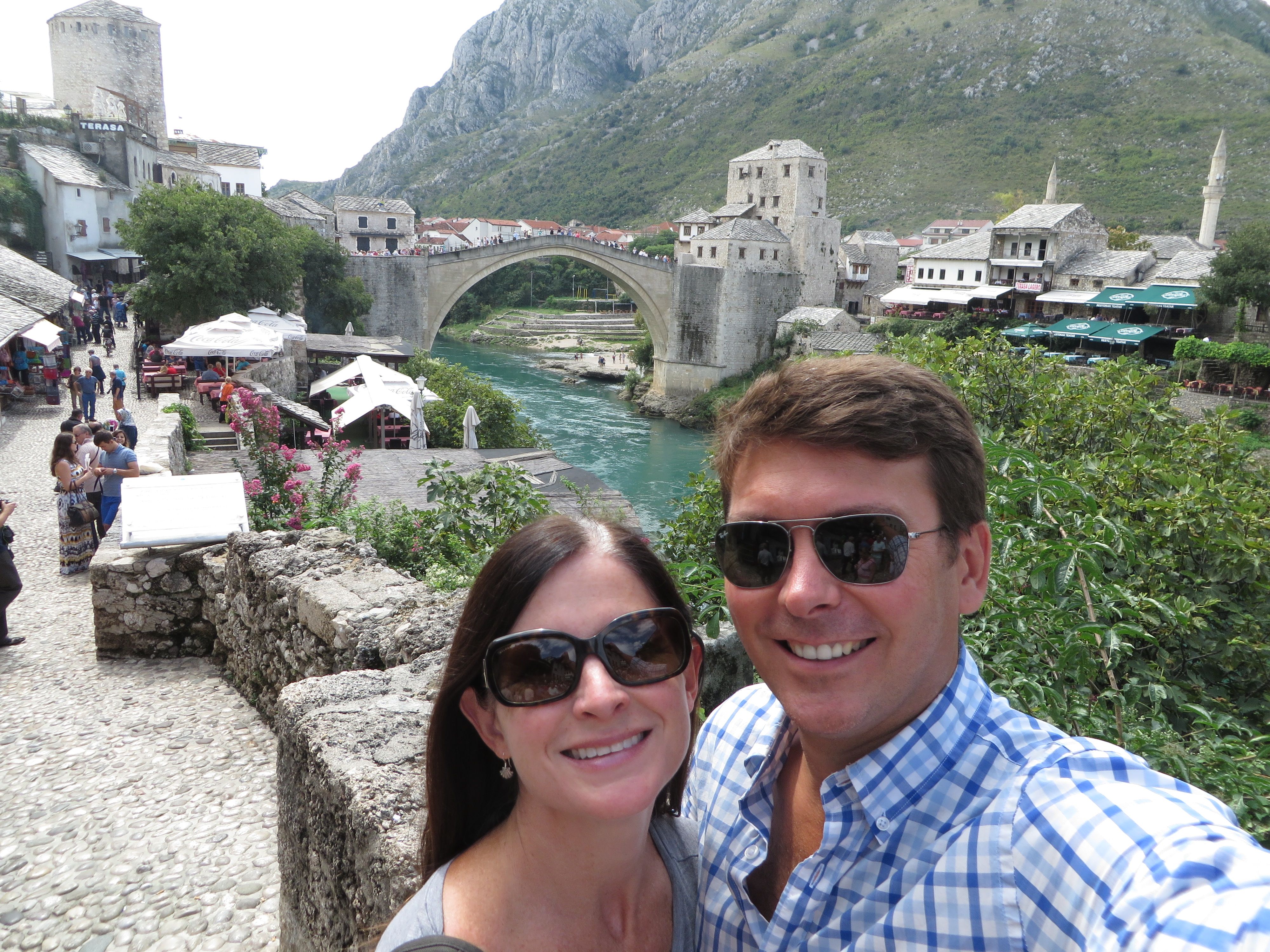
Last week Amy and I found ourselves visiting Bosnia & Hercegovina. That’s right, THAT Bosnia. And Hercegovina.
We’d been in Croatia for a little over a week, and then Montenegro for four days, and since we still needed to be in the Balkans and out of Schengen for 21 days, we decided to visit Mostar, and then Sarajevo, before heading to – – what?…What’s that?… Oh… “SCHENGEN?” Yes, Schengen…
Let’s pause for a moment here. Some folks reading this will know about Schengen, but most will not. We’d never heard of Schengen either, until learning about it on this trip. The Schengen Area is a common visa area in Europe. A number of countries, mostly in the EU, agreed to allow travelers to roam freely within the area without border checkpoints, and with just one passport stamp. It’s similar to the Eurozone, but also includes countries that aren’t in the EU, like Switzerland and Norway. And the UK and Ireland, who ARE in the EU, opted OUT of Schengen, which is why you get a different passport stamp when you land at Heathrow or Dublin. Weird, right?
But here’s the even bigger hitch – the tourist visa is for 90 days out of a 180-day period. So over the course of six months, you can only be in Schengen for 90 days, breaking it up however you want to over that period.
As a couple of tourists, with a rental car, traveling through Europe for nearly five months of our 14-month world tour, this put a bit of a wrench in our plans. Or, if you’d prefer, “a spanner in the works.” Either way, it caused us a lot of headaches and worries. How do we avoid getting fined, arrested, or deported after 90 days of our nearly five-month stay? We worked it out: we’d finish our trip in the UK and Ireland, spending the last month or so there. But that still left us with 21 days we’d need to be out of Schengen. And who’s not in Schengen? The Balkans.
So somewhere close to halfway through our stay in Europe, we found ourselves deciding to spend five days in Bosnia & Hercegovina. Bosnia obviously conjures up some vivid images, most from the early Nineties, and none of it very touristy. I think of the time I told my mother that I was going to Vietnam: she didn’t like the idea. And in all honesty, when I thought about Bosnia, all I could think of were terms like “ethnic cleansing.” It made me wonder what we were getting into.
Well…it was awesome. I really enjoyed Bosnia.
It’s a surprisingly beautiful country. It’s got all the “old world” charm you expect in Europe, but with a touch of the eastern Ottoman influence. It’s inexpensive, and the people we met were generally very friendly, very well-educated, and the people all over the Balkans speak better English than any other place we’ve been (well, you know, where English isn’t the native language). It made for a great tourist destination.

Our first stop was Mostar. It’s a small, compact city on the Neretva River, dotted with spires and minarets. The old town, with its stone buildings and cobbled streets, is centered around Stari Most, the pedestrian bridge spanning the river. The original bridge was built by the Ottoman Turks in the 16th century, and it became a symbol during the Bosnian War when it was destroyed by Croat artillery (you can find video on YouTube). Since then it’s been rebuilt and recognized as a UNESCO World Heritage Site, and it should be.

The sad truth is, the whole area around the bridge, and a lot of the city, had to be rebuilt. Mostar got pounded in the Bosnian War – the front line ran right down the street where we stayed, and you can still see remnants of the battle scars.
-

- Near our stay
-
- Old hotel
But the people of Mostar, and Bosnia in general, are trying to get beyond those days and move forward. They’re not dwelling on the war. And they’ve set up a good tourist industry: we went to a really good wine bar (surprise), and escaped the rain in nice little dive bar (surprise), and ate at a few of the restaurants overlooking the river (surprise). At night, with the lights twinkling, and a slight mist on the river, it’s pretty romantic.
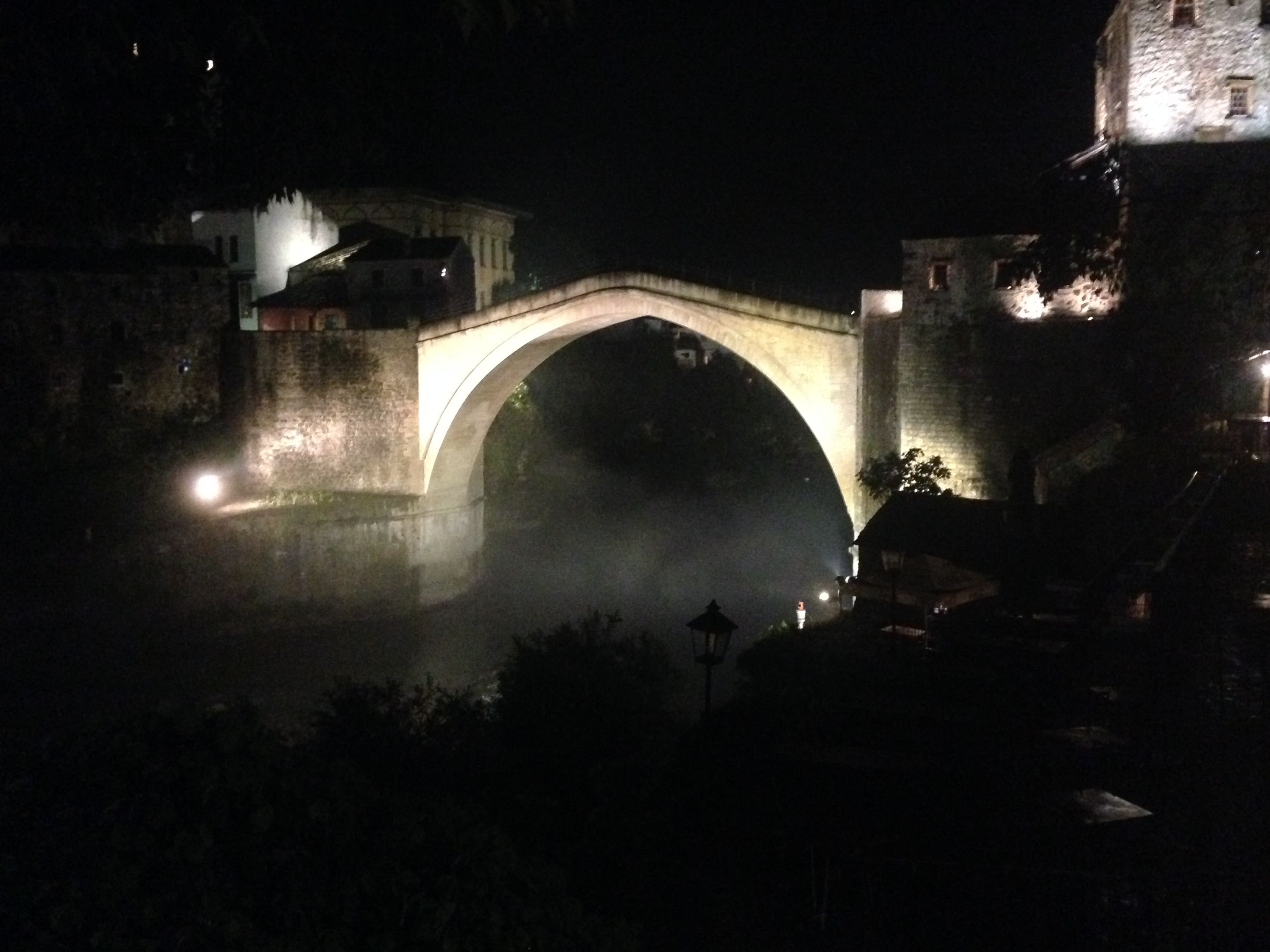
And if you don’t believe me when I tell you it’s romantic, then ask either of the two dogs we saw at the foot of the bridge, humping with great ferocity, as tourists walked by taking selfies. Marlin Perkins would have loved it. And another interesting sight on the bridge (other than dogs in throes of passion): divers. The local bridge diving club will send a guy to the top of the bridge, and they’ll collect money from the passers-by. Once they have enough money in the hat – off he goes into the rushing waters below…
-
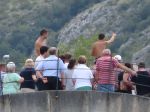
- Collecting money…
-
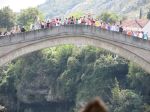
- Getting ready…
-
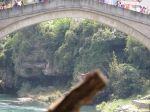
- On his way in…
If you recall from an earlier post, I was a “championship” diver in high school, having placed 16th in the New York State Section V regionals in 1986. I told Amy that I wanted to give it a try. Apparently they let tourists do it for 25 euro, covering the costs of a quick tutorial, a wetsuit, and, if necessary, a guy who’ll fish your dead body out of the water downstream, after you’ve plunged to your death because you’re an out-of-shape, forty-six year old tourist. I was forbidden from doing so.
We also saw a couple of mosques (which got shelled during the war), and strolled through the marketplace, which sold a lot of Turkish metalwork, flowery ceramics and beads, and some things you can’t get in the USA like coffee mugs, t-shirts, keychains, and lighters. Mostar was pretty cool for a couple of days (which is really all you need); I just wish it hadn’t rained so much. I also wish we weren’t sleeping one block away from a minaret that blasted the call to prayer at 5:30am, but that’s my luck, and that’s living in a predominantly Muslim area, and that’s Mostar.

Our next stop was Sarajevo. The drive from Mostar to Sarajevo was one of the most beautiful drives we’ve had on the trip. We took two-lane roads through the countryside, past lush green mountains, winding rivers with clear blue-green water, and bucolic scenes of cattle farms, old haystacks, and fields of corn and sunflowers. I wasn’t thrilled getting slowed down behind semi-trucks, tractors, and old men driving 1987 Yugos, but the scenery made the drive that much more palatable, and it’s not like we were in any kind of rush. Plus, Amy really loves my driving, and makes a lot of noises that indicate she feels I brake at the appropriate moment, or pass trucks with enough space in the on-coming lane.
Sarajevo itself is considerably bigger than Mostar, but no larger than any mid-sized American city like, for example, Rochester, New York. And like Rochester, New York, there’s an older downtown part of the city, right on the river, and then the suburbs, and the malls, and the airport, and all the other trappings of modern civilization. But unlike Rochester, Sarajevo’s nearly a thousand years old, and has an incredibly storied past.
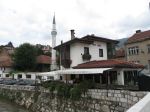
For example, our apartment rental was very close to the old city, just on the other side of the Miljacka river, and just a stone’s throw from the bridge that got us there, the Latin Bridge. The Latin Bridge is famous because of what happened there on a certain June 28th, back in 1914. Here’s a small list of things that have happened on June 28th:
Famous Birthdays: Mel Brooks, Gilda Radner, John Elway, John Cusack. Me.
Famous Assassinations: Archduke Franz Ferdinand, in Sarajevo, igniting the First World War.

For my entire life, every time I read about my birthday, there’d be one of these notes: “On this day in 1914, Archduke Franz Ferdinand was assassinated in Sarajevo, igniting the First World War.” I really had no idea what that meant as a kid, but whenever I heard about Sarajevo, there I was, thinking “Hey! – that’s where Archduke Franz Ferdinand was assassinated in 1914, igniting the First World War.” And then sure enough, here we were in Sarajevo, and one of the first things we saw was the Latin Bridge, and the site of the assassination, the one that ignited the First World War. (By the way, if you’re into history at all, you should definitely read about the assassination, if only in brief. It really is a comedy of errors, including one co-conspirator who jumped in the river to drown himself, only to find the river was four inches deep.)
The old town in Sarajevo is similar to Mostar in some ways – great old stone buildings, cobblestone streets, and a wealth of historic Ottoman markets and mosques. But there’s also a mix of great architecture from the Austro-Hungarian days. It’s a city where East meets West.
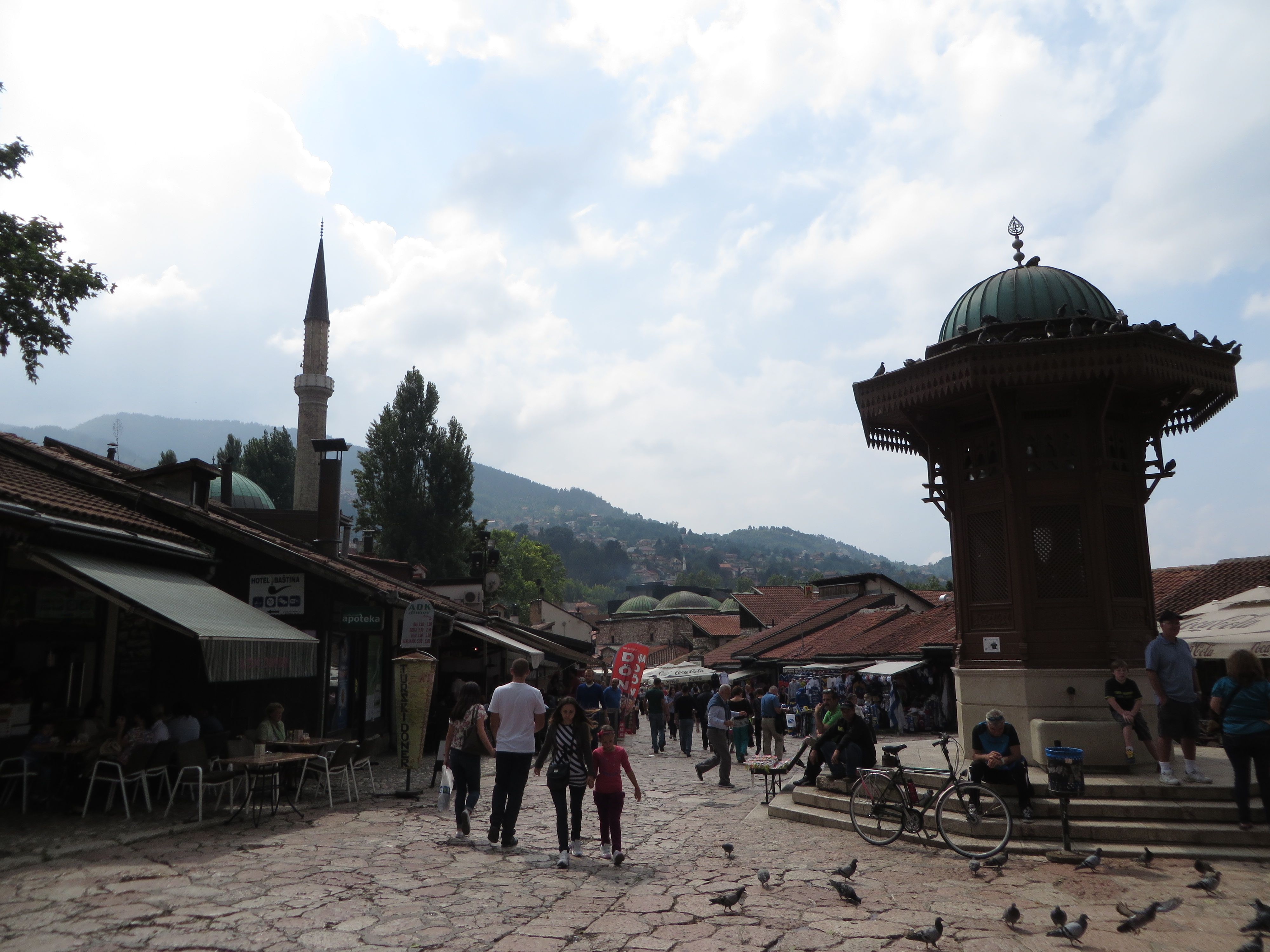
One of our days there was a Saturday, and that night we looked for a place to go out and have some weekend fun. We walked around and saw a bunch of touristy looking pubs, some touristy looking cafes, and, as with all Muslim towns, hookah cafes, with people smoking fruity flavored tobacco and drinking coffee. No beers there. But then we found our place.
I want to give this piece of advice to all people traveling, something Amy first picked up on, which has been a foolproof indicator for us on this trip: If you want to find a good, inexpensive, local place to have a few relaxed beers, look for the place with the 60-year old men sitting at a table with their dogs, reading the newspaper. Old men know the places that are cheap. They know where to sit and watch the world go by, and they don’t suffer fools. If you find a dingy looking place filled with old men, you’ve found the best watering hole in town.
Amy noticed a bar that looked like it fit the bill, and I agreed. We went in, and as with every one of these places, we got the initial stare: who are these tourists? But as with every place, people made room at the bar, turned their attention back to their drinks, and gave us the quick nod that said, silently, “welcome to my local.”
Then a table of young men turned to us, made room in their booth, and in perfect English said, “would you like a seat?” Amy and I moved in and sat with four guys who were sharing a bottle of brandy. Their English was so good, at first I thought they were Irish or Australian. But as we struck up a conversation with the four, we found out that they were all high school buddies from Sarajevo. And by “high school buddies,” I mean that the four of them were literally in high school. They were all 17! Apparently the drinking age in Bosnia is 18, but it’s policed about as liberally as checking ID’s at an R-rated movie. Nobody cares. So the six of us drank together for an hour or so.

These four kids couldn’t have been nicer or more well-mannered. We spoke about our trip, our former jobs, their school, their plans for the future, and mostly about life in Bosnia. What I found most fascinating was how they felt about the Bosnian conflict. They were all born after the war, but they all had some sort of story – how parents met during the war, family members who died. But they made a point of mentioning how they want to move forward, how people have reconciled, the mix of Bosniak, Serb and Croat; Muslim and Christian. All four of these kids were raised Muslim, yet there they were, at a bar, out having a good time with everyone else. It gave you great hope for their future, and the future of the country. Then again, we were doing shots of cherry-flavored brandy with a group of teenagers, we all killed the bottle, and then they left to go clubbing, while Ma and Pa Brueckner studied a map trying to figure out how to get home. They’ll probably be fine.
The next day, on the recommendation of these guys, we drove a bit out of town towards the airport to visit “The Tunnel of Hope.” Back during the Siege of Sarajevo in the early 90’s, the entire city was surrounded by Serbian forces. This went on for nearly four years, at the cost of thousands of lives. The only way the people of Sarajevo could link up with the outside world was through a tunnel running under the UN-controlled airport that provided a vital lifeline, bringing in food, supplies, and, because of an international arms embargo, weapons.
-
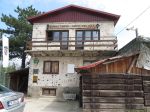
- House where the tunnel is located
-

- Entering the tunnel

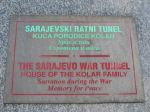
It was fascinating to learn about this piece of history I’d never really known about. Remember how I mentioned the destruction of Mostar? Sarajevo had it real bad, too. Really, really bad. Like over 300 artillery shells a day. Driving through town, we saw cemeteries filled with headstones from the 90’s.
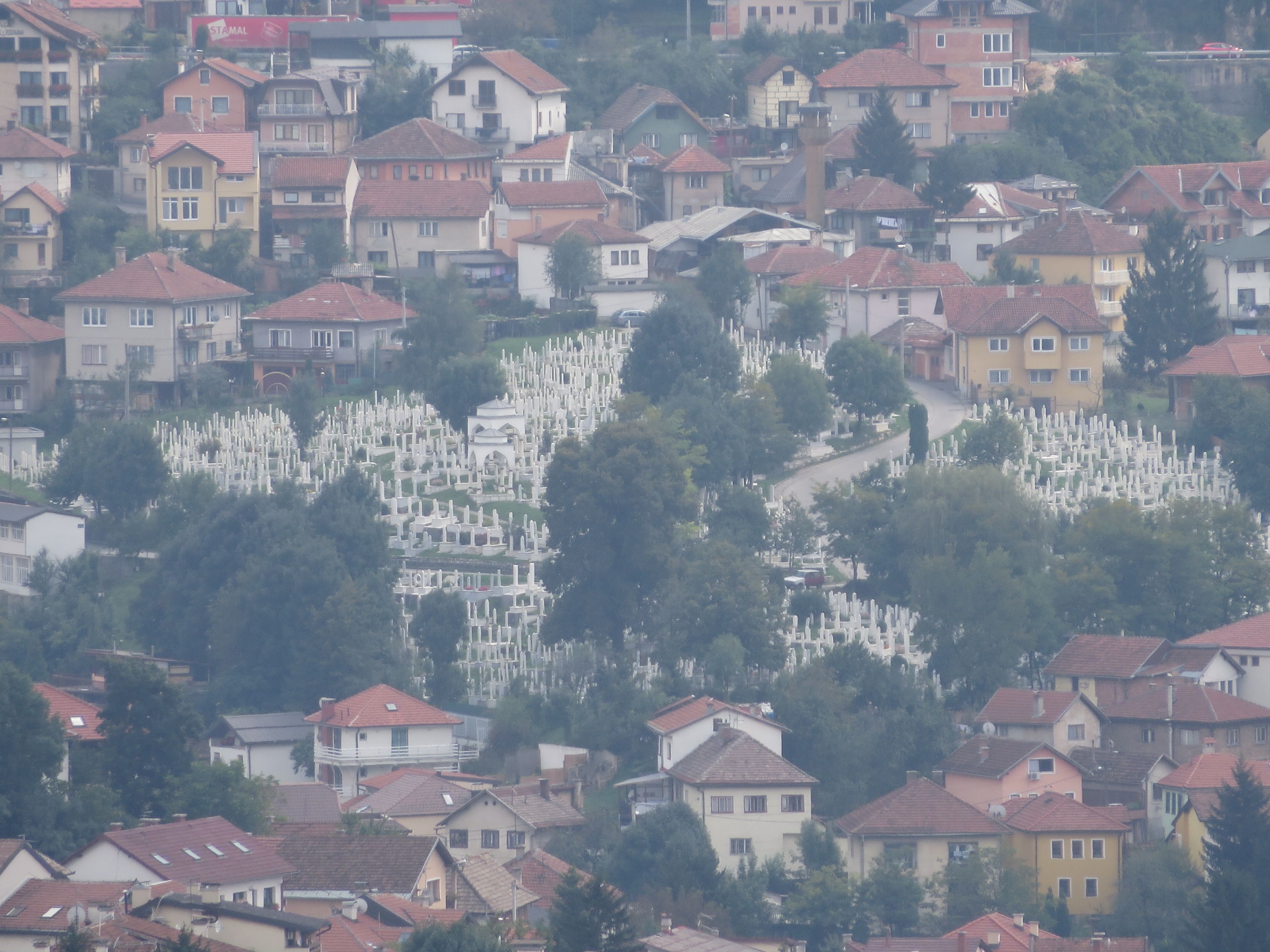
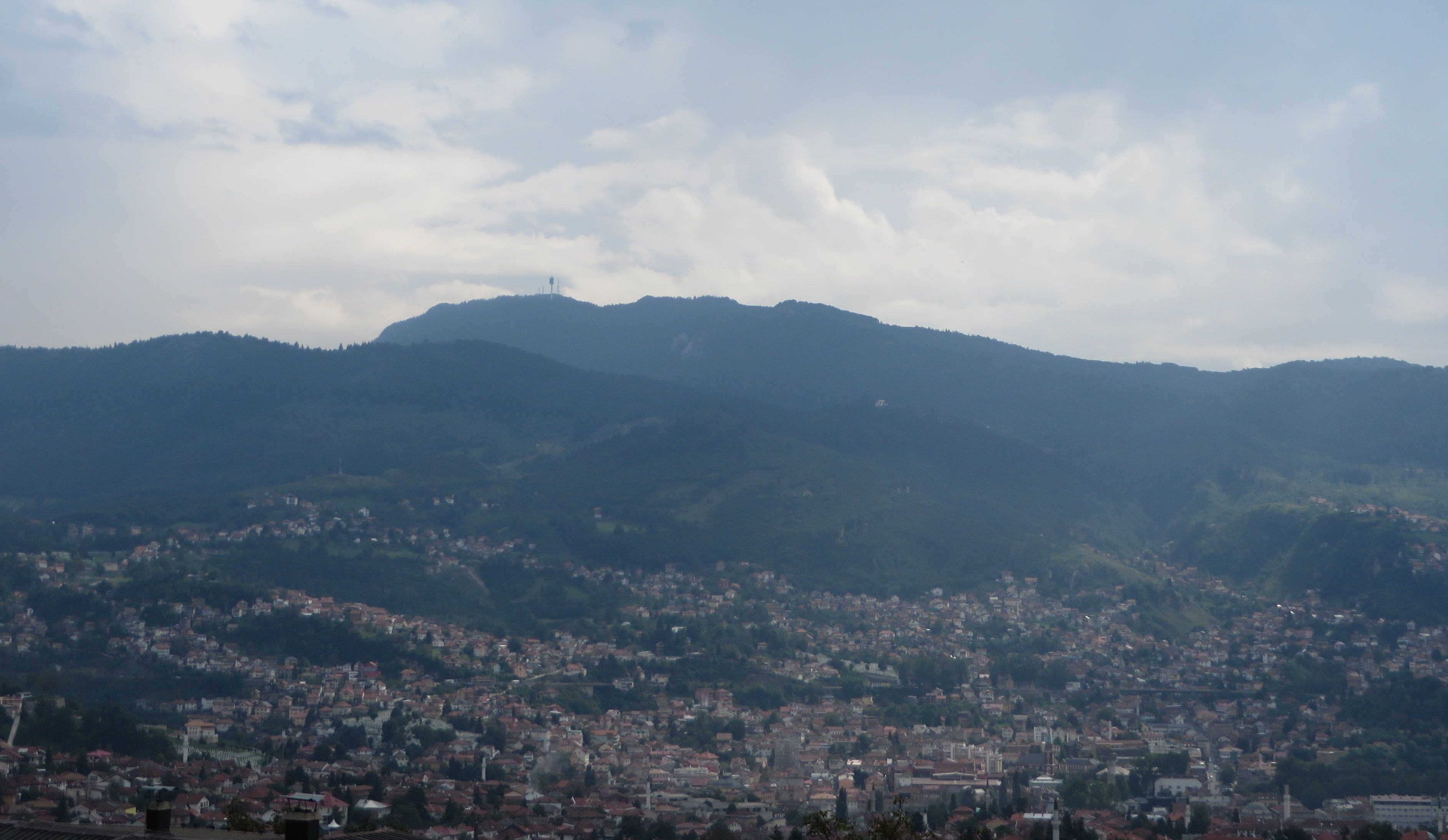
The city seems alive and vibrant now. It’s been rebuilt for the most part, and like many of its residents, the scars may remain, but it’s moving forward and doing its best to live peacefully and put its past behind. Amy and I spent one afternoon at a truly fantastic hillside restaurant. From that vantage point, looking down on Sarajevo, it was hard to imagine what things looked like just 20 years ago. It was a beautiful view.
But one more very important thing. You would think after an assassination, the Nazis, communism, and a civil war, the people of Bosnia have suffered enough. But then there’s this:
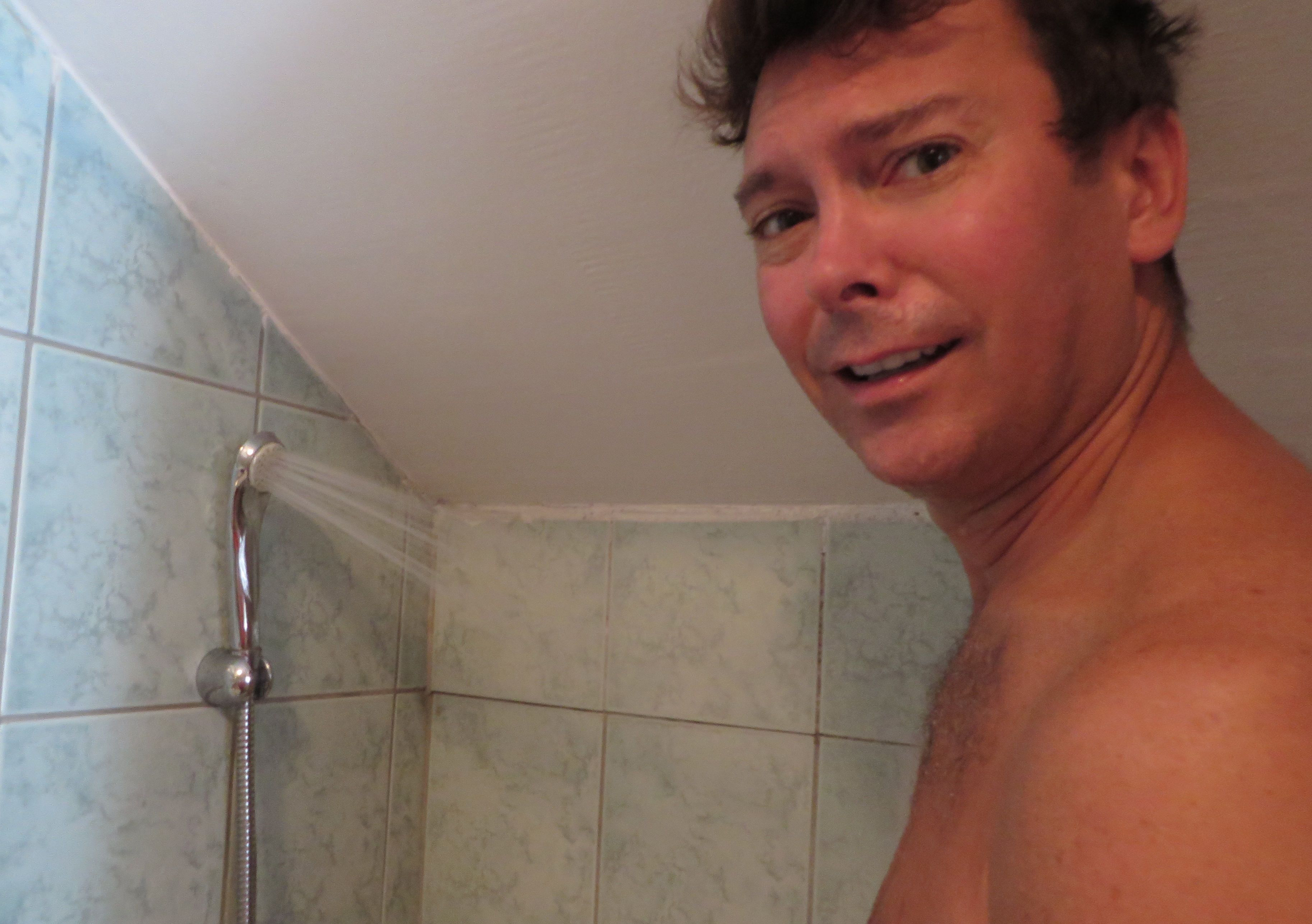
This was the shower in our place in Mostar. As you see above, it sprayed directly on my chest, and I had to hold my head at an angle in order to avoid hitting my cranium on the slanted ceiling above the tub. I had to wash my hair while down on my knees. You would think it couldn’t get any worse. Until Sarajevo…
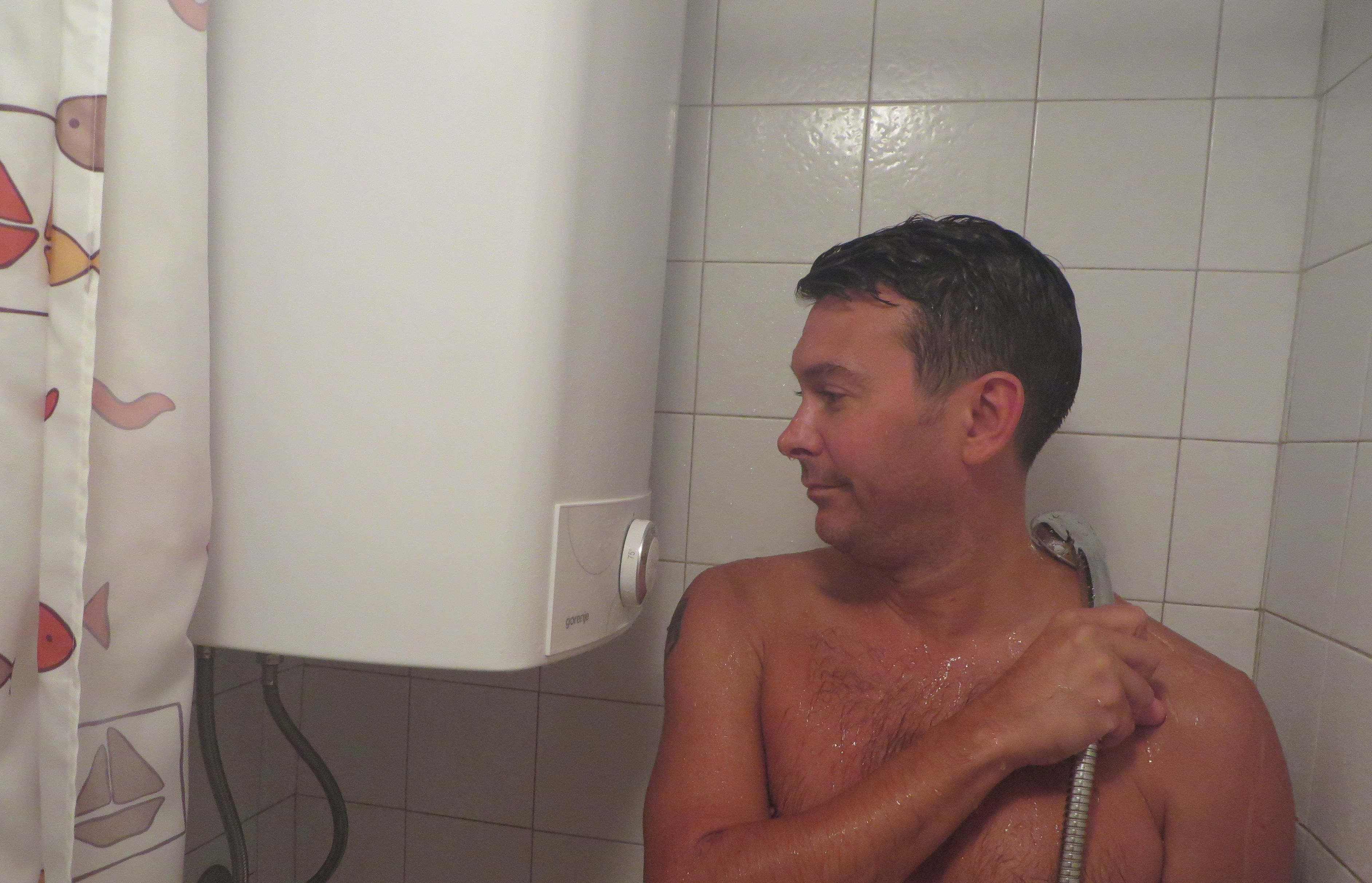
Here I am, standing in a small three-foot tub, holding the shower head in one hand (because there was no fixture to hold it), while avoiding the hot water heater that, in a feat of Soviet-era engineering, was conveniently located ABOVE said three-foot tub! The soap dish and tap were located under the hot water heater, so I had to crouch down to turn on the water or grab the soap, all while clutching the shower head in my other hand. To add to the indignity, on one occasion, I hit my head on the bottom of the hot water heater while trying to adjust the water temperature.
It’s enough to make you wanna ignite a world war.
– – – – POSTSCRIPT – – – –
Way back when we were in Ho Chi Minh City, we were connected with a couple who had recently moved to Vietnam. We’d been introduced through mutual friends, so you never know how these blind double-dates will go, but as it turned out, they were fantastic hosts, and we had a great evening. Amy kept in touch with the wife, and by coincidence, she was going to visit her native Sarajevo around the same time we were there, but unfortunately we missed her by a week or so. But she did ask us what we’d done while we were in her hometown. Amy wrote back and listed some of the places we visited, and just before we finalized this post, our friend replied, saying “The Tunnel of Hope? Is that the one under the airport? I escaped through that tunnel in 1994!”
 werefinemom.com
NEED OKTOBERFEST BLOG
I wish I could unsee the images on John taking a shower.
I like your belly!
Love the slanted ceiling shower. It must be what Lars goes through when they visit us and stay in our attic guest room!
Here we are, living in the USA, bitching about this or that and you met someone who “escaped through that tunnel in 1994”. Perspective.
Jennifer Lawrence cautions you to be very careful with those shower photos.